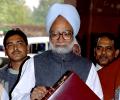
'We are going to need more technical people in government.' 'You can't expect a generalist to understand the complicated world of financial engineering.' 'I regret to say that most of our politicians have no competence to deal with these things. Nor is there a willingness to learn.'

Reserve Bank of India (RBI) on Wednesday upped inflation projection for the current fiscal to 6.7 per cent from 5.7 per cent forecast in April. RBI Governor Shaktikanta Das said the upside risk to inflation persists and the recent spike in tomato prices would fuel food inflation. Also, high global crude oil prices would add to the upside pressure on inflation. The upward revision in inflation projection comes as domestic retail inflation has remained above RBI's comfort level of 6 per cent for four months in a row, mainly due to the Russia-Ukraine war which has impacted the prices of commodities across the globe.

Finance Minister Nirmala Sitharaman is likely to hold pre-budget consultations with industry chambers on June 20, sources said. The budget for 2024-25 fiscal is likely to be presented in Parliament in the second half of July. Industry sources said the pre-budget consultation with Sitharaman would be preceded by a meeting with Revenue Secretary Sanjay Malhotra on June 18.

Automobile dispatches from companies to dealers rose 12 per cent last year compared to 2023 on the back of positive consumer sentiments which aided robust demand for two-wheelers, industry body SIAM said on Tuesday. Total wholesales across categories rose to 2,54,98,763 units in 2024 against 228,39,130 units in 2023, a growth of 11.6 per cent.
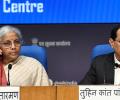
'Our attempt to honour the taxpayer has been since 2014 and more actively since 2019-2020 onwards.'

Retail investors have become a force to reckon with in the last 10 years with their ownership of Indian equities rising 800 basis points, or 8 per cent, to 23.4 per cent during this period, suggests a recent note from Morgan Stanley. This number, Morgan Stanley said, is set to rise in the next few years as Indian households are still underinvested in equities. India's demographics, policy framework, investor education and modest positive real rates, it said, will fuel the 'equity cult' in India.


'For the past number of weeks, you and I have found ourselves at odds about the best path forward for Canada'

'Whether I am optimistic or pessimistic is not the issue; I am just going by the evidence available.' 'The Indian economy and financial sector are now well-placed and very resilient in dealing with any kind of spillover coming from the external world.'

On the back of sound macroeconomic policies and softer commodity prices, India's growth momentum is likely to be sustained in 2023-24 in an atmosphere of easing inflationary pressures, said the Reserve Bank's annual report released on Tuesday. It, however, added that slowing global growth, protracted geopolitical tensions and a possible upsurge in financial market volatility following new stress events in the global financial system could pose downside risks to growth. "On the back of sound macroeconomic policies, softer commodity prices, a robust financial sector, a healthy corporate sector, continued fiscal policy thrust on quality of government expenditure, and new growth opportunities stemming from global realignment of supply chains, India's growth momentum is likely to be sustained in 2023-24 in an atmosphere of easing inflationary pressures," it said.

'I am optimistic about the Budget because of the fiscal discipline the government has committed to.'

'Investors can consider staying invested in long duration products as there is a possibility of rate cuts in the near term.' Positive macros - lower inflation, high forex reserves and favourable demand-supply dynamics for government bonds - make a strong case for rate cuts from December, says Devang Shah, head of fixed income, Axis Mutual Fund. In an interview with Abhishek Kumar in Mumbai, Shah says this view may not hold true if commodity prices go up sharply.

S&P Global Ratings on Wednesday upgraded India's sovereign rating outlook to positive from stable while retaining the rating at 'BBB-' on robust growth and improved quality of government expenditure. S&P said it could upgrade India's sovereign rating in the next 2 years if the country adopts a cautious fiscal and monetary policy that diminishes the government's elevated debt and interest burden while bolstering economic resilience.

Now that the economy is growing at a higher-than-expected rate, it is time to accelerate the pace of fiscal consolidation, and the Budget could be a good starting point, argues Rajesh Kumar.

'Nearly 10 million people will benefit from the increase in the rebate limit for those earning up to Rs 12 lakh.' 'We expect all that money will come back into the economy in either savings, consumption, or investments.'

'Investors looking at the next 6-12 months can be certain that the Fed will maintain its easing cycle, and we expect the overall environment to be conducive for fixed income investments for portfolio diversification.'

Households are likely to remain the primary net lenders to the economy in the coming decades.
The government on Monday lowered the growth projection for the current financial year to 5.7-5.9 per cent from 7.6 per cent estimated earlier, while pitching for supportive monetary and fiscal policies to improve investor confidence.
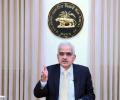
The challenge for the RBI in 2024 is likely to be less about containing elevated inflation and more about curbing excessive financial market exuberance and a 'problem of plenty', notes Sajjid Chinoy, Chief India Economist JP Morgan.

Automobile retail sales in India declined 9 per cent year-on-year in September amid a massive buildup of passenger vehicle inventory due to sluggish demand, dealer's body FADA said on Monday, urging original equipment manufacturers to take corrective steps. The overall registrations declined to 17,23,330 units last month from 18,99,192 units in September 2023, as most of the categories including passenger vehicles and two-wheelers witnessed a year-on-year (Y-O-Y) drop.

Chief Economic Advisor (CEA) V Anantha Nageswaran considers absolute poverty a more direct and pressing concern for India. He argues that inequality is a relative concept. Simultaneously, with formerly economically deprived sections joining the ranks of the middle class, policy attention needs to extend beyond 'roti, kapda, makaan' to keep the growth engine up and running.

Why did the political system in the country react to these two decisions of the Modi government in a diametrically opposite manner? asks A K Bhattacharya.
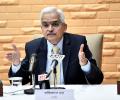
Key lending rate (repo) raised by 50 basis points to 4.9 per cent; 2nd increase in 5 weeks

Inflation to peak in the current quarter within tolerance band, moderating in the second half of next fiscal, says central bank.
'He will be remembered more for what he did as finance minister -- as someone who functioned well when the political fallout was taken care of.'

The government should frame new policies to assure growth.

Few finance ministers announce any taxation measure that could upset the stock market. Ms Sitharaman decided to take that risk, observes A K Bhattacharya.

India needs to create buffers for future economic downturns.

Sitharaman exhorted the states to work together with the Centre, stating that while the Union government sets the direction of economic growth, it is for the states to ensure effective implementation on the ground.

Chief Economic Advisor V Anantha Nageswaran on Thursday said the economy is expected to grow at 6.5 per cent in the current fiscal notwithstanding deficient rains in August. India recorded economic growth of 7.8 per cent in the April-June quarter of 2023-24 against 13.1 per cent in the year-ago period. India's economy in Q1 grew at the fastest pace in a year, on the shoulders of a boost in capital expenditure both at central and state levels, along with stronger consumption demand, especially in rural areas, and improved performance in the services sector, he said.

The Union government could target a fiscal deficit of 5.8-6 per cent of nominal GDP for 2023-24, and it should continue its capital expenditure push and look to simplify the personal income tax regime, economists recommended Finance Minister Nirmala Sitharaman and her team during their pre-Budget interaction on Monday. Starting last week, Sitharaman had eight pre-Budget consultations this time. More than 110 invitees representing seven stakeholder groups participated in these meetings, the finance ministry said in a statement. The stakeholder groups included representatives and experts from agriculture and agro-processing industry; industry, infrastructure & climate change; financial sector and capital markets; services and trade; social sector; trade unions and labour organisations; and economists.

Striking a different note from its peers, US brokerage Bank of America Securities has maintained that the Reserve Bank will leave rates unchanged next week, recognising growth-focused and capex-driven fiscal expansion, which though poses huge price pressure and interest rate risks later. The RBI's rate setting panel Monetary Policy Committee (MPC) will begin its deliberations next Monday and announce the policy moves on Wednesday (February 9) in the backdrop of a massive spike in bond yields post the Budget. Almost all major central banks are in the process of hiking rates to tame inflation.
The Reserve Bank of India on Thursday decided to keep policy rate unchanged for third time in a row as it maintains heightened vigil on inflation. The rate increase cycle was paused in April after six consecutive rate hikes aggregating to 250 basis points since May 2022.

'We face the risk of remaining a low-income country for a very long time unless something changes in the next few years.' 'Instead of constantly talking about becoming a developed economy, we need to start fixing the problems of the economy one by one.' 'There is so much potential, and we are squandering away the opportunity.'

The government will provide Rs 11.11 lakh crore for capital expenditure for 2024-25 and introduce viability gap funding to spur private investment in infrastructure, Finance Minister Nirmala Sitharaman said on Tuesday. Presenting the Union Budget for FY2024-25, she said that the government will endeavour to maintain strong fiscal support for infrastructure over the next five years, in conjunction with imperatives of other priorities and fiscal consolidation.

In the e2W category, which accounts for more than 60 per cent of total EV sales, volumes fell 15 per cent to 118,944 units in November, compared to 139,787 units in the previous month

'The Budget needs to focus more on social welfare schemes.'

The recent stimulus measures announced by China have seen most analysts sit up and take notice.

With Donald Trump all set to become US president, Indian exporters may face high customs duties for goods like automobiles, textiles and pharmaceuticals if the new US administration decides to pursue the 'America First' agenda, opined trade experts. Experts also said that Trump could also tighten H-1B visa rules, impacting costs and growth for Indian IT firms. Over 80 per cent of India's IT export earnings come from the US, making it vulnerable to changes in visa policies.

Very gradual fiscal consolidation glide path with looser-than-expected fiscal policy; good quality spending mix and reasonable assumption on fiscal math; and focus on privatisation, asset monetisation and long-term funding for infrastructure investments, according to Morgan Stanley, are the three key themes from the Budget 2021.
 © 2026 Rediff.com - Advertise with us - Disclaimer - Privacy Policy - Sitemap - Feedback - About us - Terms of use - Grievances